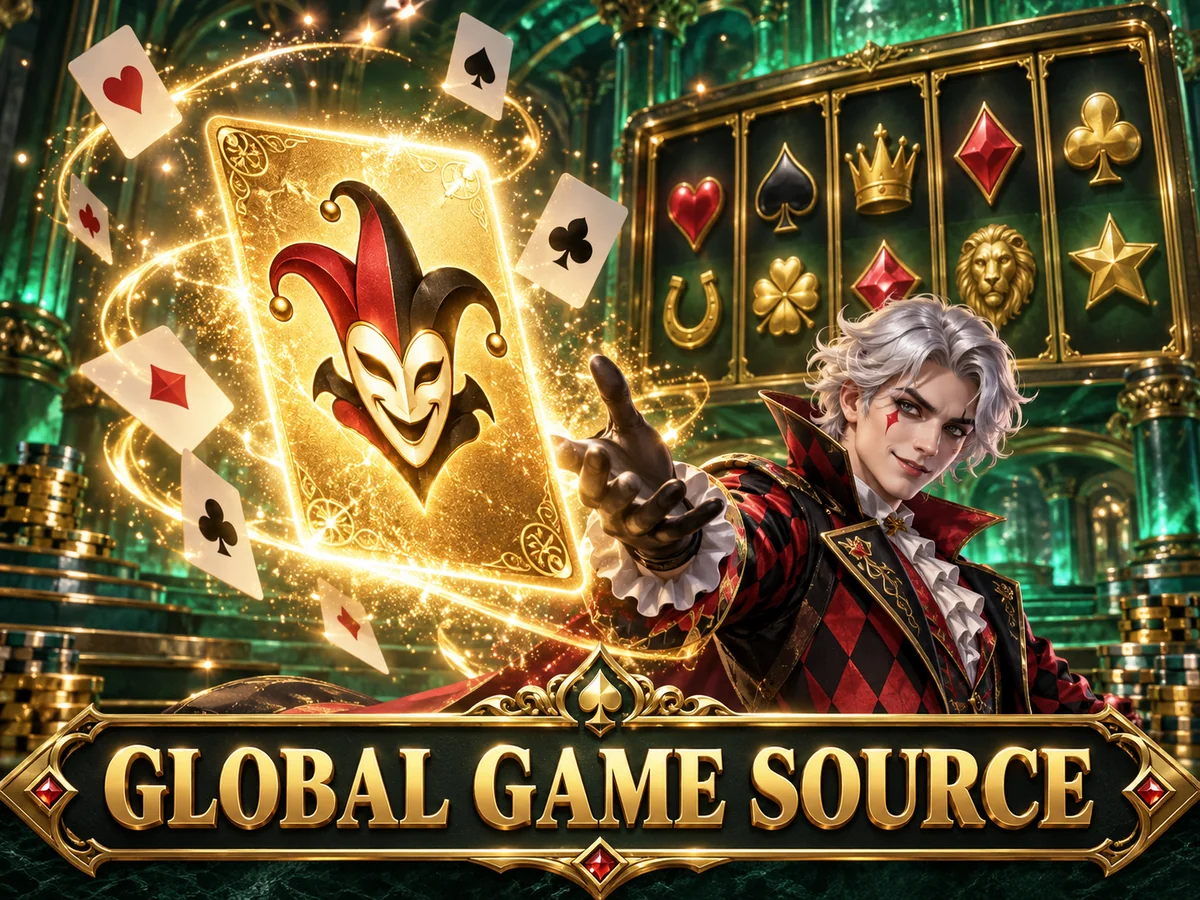
Playing cards are a visual language many players recognize immediately. Super Ace does more than place a deck on a set of reels. JILI gives a golden card a second role: it participates in the current result, but its transformation can also matter to the board that follows. The question becomes not only whether a combination has formed, but what that particular card will become next.
Give a symbol a continuing role
JILI's official page lists 1,024 ways and describes accumulated multipliers through consecutive eliminations, doubled multipliers in the free game and a Golden Joker appearing after a Golden Card is eliminated. Familiar card symbols provide quick recognition; the special golden card points toward a continuing state.
The appeal is that the change has a visible setup. The player sees a special card, sees it take part in a result and then sees what remains after the transformation. One image explains the next. Compared with simply enlarging a win counter, it creates a small sequence the player can follow.
Make the special state recognizable
If a regular card and a golden one differ only slightly in brightness, they can become difficult to distinguish on a phone. A stronger approach is to separate a special state through silhouette, material and a short, purposeful motion. The player should be able to find it before the action, recognize the change and locate it again after the refill.
A full-screen effect is not necessarily the answer. If the camera leaves just as the player remembers a card, then returns to a changed board, the connection may be lost. In an original playing-card slot, presentation time is well spent on explaining what changed in place. A readable transformation can communicate more than a burst of fireworks unrelated to the board.
Secondary development needs the states in the project
A request for JILI game source code often reflects a product the customer wants to keep adapting. A playing-card theme today may lead to revised symbols, a new character or integration with another lobby later. A special card represented only by a hard-coded animation can make those revisions awkward. Explicit states make it easier to keep the client presentation and server result aligned.
In an original cascading project, the appearance, winning participation, transformation and persistence of a special card should each have a clear record. The client can stage the sequence from those records and reconstruct the correct board after a reconnect. The animation should explain a determined result, not determine the result itself.
KuuGe offers independently developed source code, custom slots for secondary development and game API services. Whether a project targets a Southeast Asian lobby or another overseas audience, a playing-card theme can develop its own artwork and character identity. Giving familiar symbols a fresh relationship over time is a more useful starting point than adding decoration alone.
Reference: JILI Games — Super Ace
Continue exploring
- Starlight Princess 1000: Knowing When the Character Beside the Reels Should Be Quiet
- Lucky Neko: When a Familiar Mascot Becomes Part of the Game's Language
- Jackpot Fishing: Making Every Action Read Clearly in a Busy Ocean Arcade
Explore KuuGe source projects for secondary development · Browse all projects and guides